Source Document Management for Pharma Teams That Scales
Learn what source document management means for pharma MOA content, from ingestion and referencing to versioning, compliance and The Hub for MLR-ready outputs.
Source document management in pharma involves creating a governed system to capture, reference, reuse, and retire scientific evidence, ensuring that all content is traceable, accurate, and inspection-ready for medical, legal, and regulatory review processes.
Why does source document management fail without a system?
A brand team often starts with good intentions. A medical writer saves a publication in a project folder. A medical director adds an approved slide to a presentation library. Regulatory colleagues circulate a newer label by email. Field medical saves a useful figure locally because it's faster than searching through several repositories.
Each action seems harmless. The difficulty appears when the team needs to assemble a defensible content package.
The writer may use a familiar paper, while the MSL team uses a newer analysis. A reviewer may approve a paragraph based on a PDF whose citation is incomplete. The source behind a claim may support the general mechanism but not the precise wording used in the final asset. By the time the MOA deck reaches MLR, reviewers aren't checking scientific meaning. They're reconstructing the evidence trail.
That reconstruction creates avoidable work:
- Source retrieval: Someone must locate the publication, internal document, or approved reference.
- Identity checking: The team must determine whether the file is current, duplicated, superseded, or incomplete.
- Claim verification: Reviewers need to connect the wording in the asset to the passage, figure, or data point that supports it.
- Reuse decisions: Teams must decide whether an approved claim can be used in another channel or needs a fresh review.
- Change control: A revised source may affect several downstream assets, but fragmented storage makes those relationships difficult to see.
Practical rule: If a reviewer has to ask, “Which source supports this sentence?”, the source governance process has already failed somewhere upstream.
AI-assisted drafting makes this weakness more visible. Automated tools can assemble content quickly from literature and internal documents, but speed doesn't establish scientific validity. A faster drafting process increases the importance of knowing where each claim came from, whether the source is approved, and where a human reviewer entered the decision.
The answer isn't to create more folders or ask every contributor to use a stricter filename convention. It's to build a system that captures evidence once, preserves its identity, links it to claims at the right level of detail, and makes approved material discoverable for controlled reuse.
What does source document management mean in pharma and life sciences?
Think of a traditional office as a library where books are stacked in different rooms, several copies have handwritten edits, and no catalog shows which edition is authoritative. You might find the information you need, but you can't reliably prove that you used the right version.
Source document management creates the catalog and the rules behind it. It identifies the source, records its status, protects its history, and connects its content to the scientific materials that depend on it.
Records management provides the historical foundation. ISO 15489 and its development as a records management standard was first published in October 2001 as the first international standard devoted specifically to records management. It was later revised in 2016, after about 15 years of use as a global reference framework. The standard established common concepts for creating, capturing, and managing records across their lifecycle.
For a pharma team, a source isn't limited to a final publication. It may include:
- External scientific evidence: Journal articles, conference materials, systematic reviews, and other approved literature.
- Internal scientific documents: Study reports, protocols, analyses, investigator materials, and approved scientific summaries.
- Controlled references: Approved labeling, regulatory documents, standard templates, and previously validated claims.
- Content components: Figures, tables, excerpts, and structured claim statements that teams may reuse in a presentation or MOA video.
A final asset is different from its sources. A slide deck, video, PDF, or field aid is an output. The sources are the evidence that supports its claims. The relationship between the two must remain visible.
The four controls that make a source trustworthy
A useful system answers four questions for every source:
- What is it? A unique identifier, title, document type, therapeutic area, and relevant metadata establish identity.
- Where did it come from? Provenance records the origin, ingestion context, and relationship to other documents.
- Can the team use it? Status, approval, access permissions, and lifecycle rules indicate whether the source is available for drafting or reuse.
- What did it support? Claim-level references connect evidence to the exact sentence, visual, or content block that used it.

This model prevents a common misunderstanding. A repository can store files without managing sources. Management begins when the system controls identity, access, version, approval, relationship, and retirement.
How does source governance determine MLR readiness for MOA content?
MLR reviewers don't approve a file in isolation. They assess whether the scientific message is accurate, appropriately supported, and suitable for its intended use. Source governance affects all three decisions.
Consider a sentence in an MOA presentation that describes a receptor interaction. If the source is attached only at the end of the deck, a reviewer must search the document to determine which reference supports the sentence. If the source is linked directly to the sentence, the reviewer can inspect the relevant evidence without reconstructing the author's reasoning.
That difference matters across a large content set. Unverifiable claims create questions. Missing provenance creates rework. Duplicate versions make reviewers uncertain about which asset reflects the approved wording. A governed evidence chain reduces those questions by preserving the path from source document to final output.
The operating logic behind review confidence
The relationship is practical:
- Ingested sources give the team a controlled evidence base.
- Structured metadata helps users find the relevant material by therapeutic area, study, content type, or status.
- Sentence-level references show exactly which evidence supports each claim.
- Validation controls distinguish approved, current material from drafts or superseded documents.
- Traceable outputs let reviewers follow the evidence chain during MLR or an inspection.
VarsaAI's citation management software is one example of a workflow designed around this claim-to-evidence relationship. The important principle isn't the interface. It's the granularity. A citation attached to a whole document is useful, but a citation attached to the precise claim gives reviewers a clearer basis for judgment.
ISO 15489 has been adopted in approximately 50 countries and translated into more than 15 languages, as documented in the International Council on Archives material on ISO 15489. That reach reinforces the broader point that structured records governance is an established global discipline, not an administrative preference limited to one department.
The MLR benefit follows from control quality. When each claim has a current, identifiable, approved source, reviewers can focus on scientific interpretation, fair balance, and intended use instead of performing document archaeology. Teams also gain a safer basis for reuse because they can see which claims are approved, where they were used, and whether a source change affects downstream content.
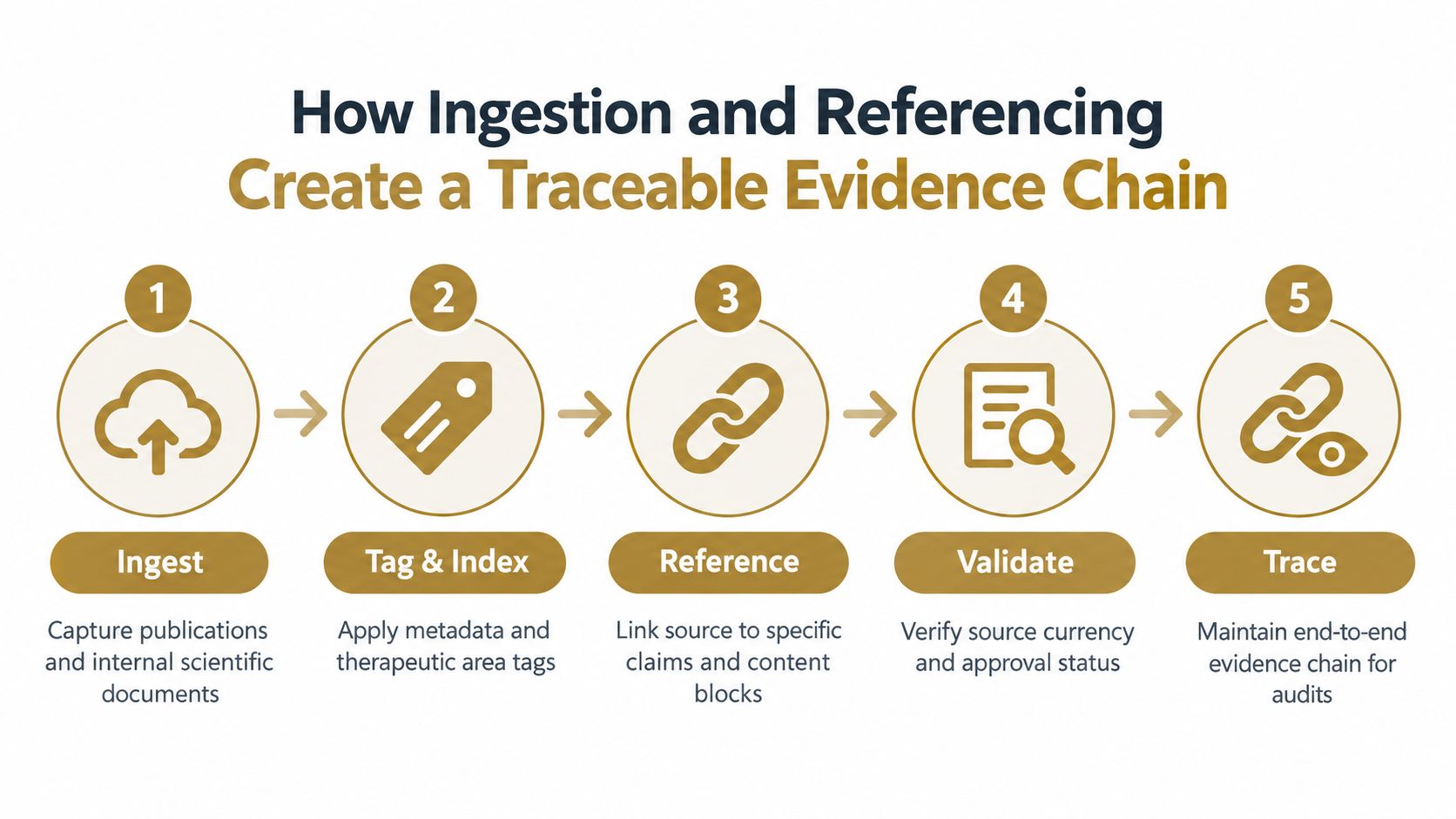
How do ingestion and referencing create a traceable evidence chain?
Traceability starts before anyone writes the first script or designs the first slide. It begins with disciplined ingestion, meaning the team brings source material into a controlled environment with enough context to identify and manage it later.
A publication imported without its citation details is only a file. A study report imported with its title, document type, therapeutic area, date, status, owner, and related content becomes a usable evidence record.
Start with controlled ingestion
Capture external and internal material through a defined intake process. The intake should preserve the original document while adding metadata that reflects how medical affairs users search and work.
Useful metadata may include:
- Source identity: Title, authors or originating group, document type, and persistent reference information.
- Scientific context: Therapeutic area, disease state, mechanism, molecule, target, study, or endpoint.
- Governance status: Draft, under review, approved, superseded, or archived.
- Ownership: The responsible function or subject matter owner.
- Relationships: Related publications, analyses, labeling, claims, and downstream assets.
A single authoritative repository with structured taxonomies, lifecycles, and workflow controls is a recognized best practice for source-document management across clinical, regulatory, quality, and manufacturing domains, as described by OpenText's life sciences document management guidance. Centralization doesn't mean every employee should see every document. It means the organization has one controlled record of what exists and how it may be used.
Link evidence at the sentence level
Sentence-level referencing changes the review task from “check this deck” to “verify this claim.” The reference should identify the source and, where possible, the relevant page, table, figure, section, or passage.
For example, a claim about a biological pathway might connect to a specific section of a publication. A claim about a clinical observation might connect to a defined table or analysis. If the wording goes beyond what the source supports, the reviewer can identify the gap before the asset reaches final approval.
The system should also detect duplicate ingestion. Two files may represent the same publication, while two internal analyses may look similar but have different statuses or scopes. De-duplication protects search quality and reduces the risk that authors select an unapproved copy.
VarsaAI's source traceability workflow illustrates the wider operating model: capture the evidence, index it, connect it to content, validate its status, and preserve the relationship for later review. Integration with operational systems can extend that chain without forcing teams to copy source information manually between disconnected workflows.
The output is more than a folder of references. It's an evidence map that tells the team what supports a claim, who governs the source, whether the source is current, and which assets may need attention if the source changes.
How does centralized storage with a hub compare to fragmented files?
Fragmented storage gives each team local convenience. A medical writer uses a working folder, field medical maintains its own library, and regulatory colleagues control documents in another system. The arrangement feels flexible until two teams reuse the same claim with different wording or attach different versions of the same source.
A centralized hub takes a different approach. It treats approved source material and reusable content as shared organizational assets, while permissions determine who can edit, approve, or use each item. The result isn't fewer folders. It's a visible source of truth for the content that teams are allowed to reuse.
Controlled document management in life sciences is a lifecycle control system, not basic storage. It uses ownership, unique identifiers, version control, review and approval workflows, access restrictions, and audit trails to keep regulated documents current and inspection-ready, as explained in Kivo's overview of document control in life sciences.
A practical comparison
| Capability | Fragmented Files | Centralized Hub |
|---|---|---|
| Source identity | Names and folder locations vary by team | Unique records and consistent metadata establish identity |
| Version control | Users may keep local copies or rename files manually | Current, approved versions are distinguishable from superseded history |
| Access | Folder permissions may not reflect medical or regulatory roles | Role-based permissions align access with responsibilities |
| Reuse | Authors search personal libraries and email attachments | Teams retrieve approved claims and source-linked materials from one governed library |
| Review status | Status may be communicated through email or filenames | Workflow states show whether material is draft, approved, or archived |
| Auditability | Evidence may require manual reconstruction | Logged actions preserve who changed, reviewed, or approved content |
| Searchability | Users rely on memory and inconsistent folder structures | Taxonomies and metadata support targeted retrieval |
What The Hub should control
A medical affairs hub should separate discovery from authorization. Users need to find relevant material easily, but search results shouldn't imply that every item is approved for every use. The system should expose status, ownership, intended audience, and reuse conditions alongside the content.
Pre-approved materials can include claim statements, figures, scientific explanations, source excerpts, and presentation components. A user might reuse an approved mechanism description in a new deck, while a medical director retains authority over changes to the wording or scientific context.
Centralization also supports consistency across channels. A field medical team, a scientific communications writer, and an MLR reviewer can work from the same governed reference while retaining role-specific access. The hub becomes the coordination layer that prevents local convenience from becoming enterprise inconsistency.
How do versioning compliance and audit trails keep content inspection ready?
A medical affairs team may open a file labeled “final” and still face basic questions during inspection. Who approved it? What changed? Which MOA claims use the revised source? Can the prior version be retrieved? A filename cannot answer these questions.
Version control should work like a chain of custody for evidence. Each source needs an owner, unique identity, current status, review path, and history that cannot be rewritten without oversight. Electronic signatures, role-based permissions, standardized templates, and scheduled reviews support that lifecycle when they match the organization's procedures.
The record should show decisions, not just dates
An audit trail earns its place when it preserves the reasoning behind each action. It should show:
- Who acted: Which user created, edited, reviewed, approved, distributed, or archived the source?
- What changed: Which version, passage, figure, or content element was revised, and how was it identified?
- Why it changed: Did a review, scientific update, correction, or governance event trigger the action?
- What became affected: Which claims, content blocks, or final assets reference the source?
- What is usable now: Which version is approved for drafting, review, reuse, or distribution?
This claim-to-evidence connection matters for MOA content. A reviewer should be able to move from a sentence in a video script or presentation to the exact source passage supporting it, then see whether that source was current when the asset was approved. Versioning therefore governs reuse, not only storage.
AI-assisted workflows make the chain more important. Guidance on GxP document management systems and AI-assisted evidence traceability emphasizes recording each claim's origin, preserving an immutable history, and ensuring that drafting uses approved or clearly cited source content. Human review remains necessary because an automated output can produce an unsupported interpretation from a legitimate source.
Automation accelerates synthesis. It does not decide whether wording is scientifically fair, appropriate for its audience, or approved for a particular use. Reviewers need visibility into the source consulted, generated wording, edits applied, and final decision. AI compliance software can support this control model when its workflows and records align with the organization's procedures.
Audit-ready practice: Keep the source, claim, reviewer decision, and output relationship together. A log that records only file movement cannot explain the scientific basis of the final message.
VarsaAI describes an enterprise security posture aligned with ISO27001 and EU AI compliance requirements. Platform evaluation should still confirm how controls map to validation, privacy, access, retention, and MLR procedures. Alignment supports governance, while documented processes and human accountability remain required.
How can pharma teams put source document management into practice for MLR-ready outputs?
A workable model can be summarized in four verbs: ingest once, reference precisely, store centrally, and version rigorously. Those actions turn source material into a managed evidence layer that supports MOA videos, presentations, PDFs, field materials, and future scientific updates.
Start with an honest inventory. Identify where publications, internal scientific documents, approved claims, labeling, and reusable content currently live. Then select a focused set of high-value sources and define the metadata, ownership, approval states, access roles, and retention rules before migrating everything.
Use this implementation checklist:
- Map the claim journey: Document how a source moves from capture to review, approval, reuse, and archival.
- Define the minimum metadata: Agree on the fields users need to search, assess, and govern a source.
- Set reuse rules: Mark which content is approved for reuse, which requires contextual review, and which is restricted.
- Require precise references: Link important scientific statements to the source passage, figure, table, or section that supports them.
- Connect outputs to evidence: Preserve the relationship between a source, a claim, and every approved asset that uses it.
- Test the reviewer experience: Ask an MLR reviewer to locate the source and verify a claim without relying on the author's memory.
- Assign ongoing ownership: Schedule reviews of taxonomies, permissions, workflows, and source status as the portfolio changes.
A governed library shouldn't make scientific reuse harder. It should make the safe path easier than searching email or copying a local file. When medical affairs, MSL, regulatory, and commercial teams work from the same evidence foundation, they can produce content with clearer provenance and fewer avoidable review questions.
Source document management is therefore not an archive at the end of the process. It's the control layer connecting scientific evidence to every claim and output that follows.
Frequently asked questions
- What types of documents are considered sources in pharma?
In pharma, sources include external scientific evidence like journal articles and conference materials, internal documents such as study reports and analyses, controlled references like approved labeling, and content components such as figures or structured claim statements. These support scientific claims in content.
- How does sentence-level referencing aid MLR review?
Sentence-level referencing links specific claims in content directly to the exact passage, figure, or data point in a source document. This allows reviewers to quickly verify scientific accuracy without reconstructing the evidence trail, making the MLR process more efficient and reliable.
- What is the role of metadata in source document management?
Metadata, such as title, authors, document type, therapeutic area, and governance status, provides essential context for each source. It helps users identify, search, and manage evidence, indicating its identity, scientific context, approval status, and relationships to other documents or claims.
- What benefits does a centralized hub offer over fragmented file storage?
A centralized hub provides unique identifiers, consistent metadata, clear version control, and role-based access for sources. This structured approach improves auditability, searchability, and safe reuse of approved content, reducing inconsistencies common with fragmented files.
- What are the key steps to implement source document management?
Key steps include mapping the claim journey, defining minimum metadata, setting clear reuse rules, requiring precise references, connecting outputs to evidence, testing the reviewer experience, and assigning ongoing ownership. This ensures a controlled and traceable evidence layer.
Add the trust layer to your LLM.
Every claim verified, every citation listed — inside your existing AI workflow.
Get pricing →